Insights

Back to insights

Carbon Monoxide and Your Boiler: Warning Signs, Alarms and What to Do

By Anthony Sanders, Gas & Heating Engineer, Smart Heating EA. Gas Safe registered, No. 602755. Last reviewed 04/11/2026.

A gas boiler that is burning properly produces very little carbon monoxide (CO). The problems start when combustion goes wrong or the fumes can’t get out of the flue. CO has no colour, smell or taste, so the only reliable ways to know it’s there are an alarm, or an engineer measuring it during a service.

This guide covers what we look for on jobs around Norwich and Norfolk, what your alarm is telling you when it beeps, and what to do if it goes off.

Can a boiler leak carbon monoxide?

Yes. Any appliance that burns gas, oil, LPG, coal or wood can produce CO. A boiler usually becomes dangerous for one of four reasons:

  • Poor combustion. The gas and air mix is wrong, often because of a worn part, dirt or a fault that hasn’t been looked at. The boiler makes more CO than it should.
  • A blocked or damaged flue. The flue carries fumes outside. Birds’ nests, debris, a crushed section in a loft, or a joint that has come apart can push fumes back into the house.
  • Failed seals. Most modern boilers are room-sealed, so the combustion chamber is closed off from the room. If a case seal or gasket fails, that protection goes.
  • Poor installation. Flues that are too long, not supported or not sealed at the joints. We still find these on boilers fitted by unregistered installers.

Older open-flued boilers and back boilers take their air from the room. They are more sensitive to blocked vents and to extractor fans pulling fumes back down the flue.

Warning signs to look out for

You can’t see CO, but you can sometimes see the signs of an appliance that isn’t burning properly:

  • A lazy yellow or orange flame instead of a crisp blue one, on any appliance where you can see the flame (gas fires, hobs, some older boilers)
  • Black or brown staining, soot or scorch marks on or around the boiler or fire
  • A pilot light that keeps going out
  • More condensation than usual on windows in the room with the appliance
  • A boiler fault code that keeps coming back after it’s been reset

If you see any of these, turn the appliance off and don’t use it until a Gas Safe engineer has checked it. They’re the same signs we listed in our Gas Safety Week checks.

Symptoms of carbon monoxide poisoning

The NHS lists headache, dizziness, feeling or being sick, weakness, tiredness, confusion, chest and muscle pain, and shortness of breath. These are easy to mistake for flu, but CO poisoning doesn’t cause a high temperature.

The pattern is often more telling

  • Other people in the house, or pets, become ill at the same time
  • Symptoms ease when you go out, or go away for a few days, and come back when you return
  • Headaches are worse in winter, when the heating runs more

If you think you have CO poisoning, call NHS 111. Call 999 if someone is struggling to breathe, confused or unconscious. See the NHS guidance for more.

Why is my carbon monoxide alarm beeping?

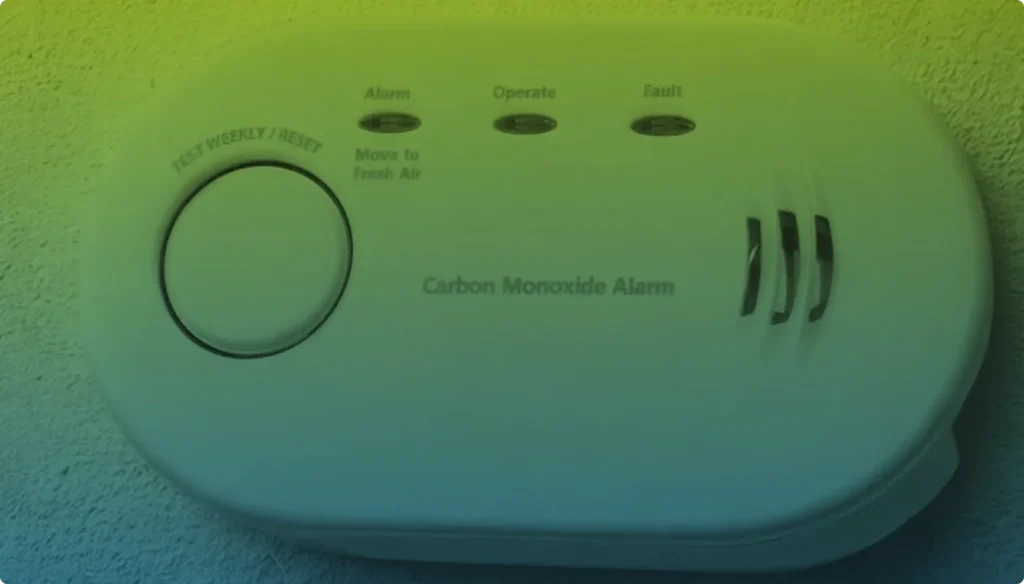
It depends on the pattern. Patterns vary by make and model, so check the leaflet or the label on the back. Most alarms follow the same broad rules:

What you hear What it usually means What to do
A loud, repeating alarm, often with a flashing red light CO detected Treat it as real. Follow the steps below
A single short chirp every minute or so Low battery, or a fault Replace the battery if it has one. If it’s sealed, replace the alarm
A chirp plus a light pattern (often amber or yellow) that won’t stop after a new battery The alarm has reached the end of its life Replace the alarm. The date is printed on the casing

Never take the battery out to stop it beeping and leave it out. A silent alarm is worse than no alarm, because you think you’re covered.

What to do if your carbon monoxide alarm goes off

  1. Open doors and windows.
  2. Turn off any fuel-burning appliances if you can do it straight away.
  3. Get everyone out of the house, pets included.
  4. Call the free gas emergency line on 0800 111 999. It runs 24 hours a day.
  5. Get medical advice, even if you feel fine: NHS 111, or 999 if anyone has severe symptoms. Don’t drive yourself to A&E.
  6. Don’t go back in, or use the appliances, until they have been checked and you’ve been told it’s safe.

Once the emergency service has made the property safe, you’ll need a Gas Safe engineer to find and fix the cause. We can do that across Norwich: contact us or call 01603 457009.

If your CO alarm goes off

0800 111 999

Gas emergency line. Free, 24 hours a day. Call it from outside the house.

Feeling unwell? Call NHS 111 for advice, or 999 if someone is struggling to breathe, confused or unconscious.

Where to put a carbon monoxide alarm

Fit one in every room that has a fuel-burning appliance: boiler, gas fire, wood burner, open fire, oil or LPG appliance. Most people also put one in bedrooms, because you won’t notice the early symptoms while you’re asleep.

The Building Regulations guidance (Approved Document J) gives the position:

  • On the ceiling, at least 300mm from any wall
  • Or on a wall, as high as possible and above any doors and windows, but not within 150mm of the ceiling
  • Between 1 and 3 metres from the appliance, measured horizontally

Avoid putting it in a cupboard, behind furniture, directly above a sink or cooker, or next to an extractor fan or open window.

Buy one marked BS EN 50291. A sealed 10-year battery alarm saves you remembering to change batteries. Test it once a month with the button.

Does a boiler service check for carbon monoxide?

A proper one does. During an annual boiler service our engineers:

  • Test the flue gases with a combustion analyser, which measures the CO and CO2 the boiler is producing
  • Check the flue along its full length where it can be reached, including joints and terminal
  • Check the case seals and the combustion chamber
  • Check ventilation, where the boiler needs it
  • Test your CO alarm, if you have one, and tell you if it’s out of date

If a service turns up a fault, we’ll explain it and give you a price for boiler repairs before doing anything.

New boilers come with a CO alarm

Since 1 October 2022, the Building Regulations in England have required a CO alarm in the room whenever a new or replacement fixed combustion appliance is installed. That includes gas and oil boilers. Gas cookers are excluded. When we fit a new boiler and the room needs a CO alarm, we add one to the job. If you’re replacing an old boiler anyway, it’s one less thing to arrange.

If you’re a landlord

In England, since 1 October 2022, landlords must:

  • Fit a CO alarm in every room used as living accommodation that has a fixed combustion appliance (gas cookers are excluded)
  • Check the alarms work on the first day of each new tenancy
  • Repair or replace an alarm once a tenant tells you it’s faulty

This sits alongside the annual gas safety check (CP12), which is a separate legal duty. The CP12 doesn’t cover your alarm obligations, so don’t assume one takes care of the other.

Councils can fine landlords up to £5,000 for breaking the alarm rules. Ask tenants to test the alarms once a month and to tell you about a fault straight away.

We work with landlords and letting agents across Norwich and Norfolk, and can keep track of renewal dates across several properties.

Heat pumps, electric boilers and off-grid homes

An air source heat pump or an electric boiler burns nothing, so it produces no carbon monoxide. If one is your only heating appliance and you have no gas fire, wood burner or gas cooker, the CO risk in your home is low. You still need a smoke alarm.

Many Norfolk villages are off the gas grid. LPG appliances carry the same CO risk as mains gas and need a Gas Safe engineer with the LPG qualification. Oil boilers produce CO too, so the same alarm advice applies. We don’t work on oil boilers: they need an OFTEC-registered technician rather than a Gas Safe engineer.

Frequently asked questions

When is Carbon Monoxide Awareness Week 2026?

Carbon Monoxide Awareness Week 2026 runs from 14 to 21 November. It’s an annual UK campaign led by the All-Party Parliamentary Carbon Monoxide Group, held in late November as people start using their heating more.

Can a combi boiler leak carbon monoxide?

Yes. Combi boilers burn gas like any other gas boiler. Modern combis are room-sealed, which lowers the risk, but a failed seal, a damaged flue or poor combustion can still let CO into the home.

Do I need a carbon monoxide alarm if I have a gas boiler?

Yes. For homeowners it’s only a legal requirement when a new boiler is fitted, but it’s the only way to detect CO between services. Landlords in England must fit one in any room with a boiler.

How long do carbon monoxide alarms last?

Usually 7 to 10 years, depending on the model. The end-of-life date is printed on the casing. Replace the alarm by that date even if it still seems to work.

Does a boiler service check for carbon monoxide?

It should. A full service includes a flue gas test with a combustion analyser, which measures how much CO the boiler produces, plus checks on the flue and seals.

Do heat pumps produce carbon monoxide?

No. Heat pumps don’t burn fuel, so they produce no CO. Electric boilers don’t either.

Who do I call if my CO alarm goes off?

Get everyone outside and call the free gas emergency line on 0800 111 999. Get medical advice through NHS 111, or call 999 if anyone has severe symptoms. Then have a Gas Safe engineer find the cause.

Book a boiler service in Norwich

We are Gas Safe registered, and we have serviced, repaired and replaced boilers across Norwich and the surrounding Norfolk villages for over 35 years.

A full service takes around an hour, costs available on request, and you get a written record of what was checked and anything worth watching

Talk to someone local

Call the office, and you will speak to someone who knows the area, not a call centre. If it is easier, send us a message and we will come back to you.

Call 01603 457009  · Monday to Friday, 8am–5pm, and Saturday by appointment only.

More insights.

Gas Safety Week 2026: The checks every Norwich home should make this week

Gas Safety Week runs from Monday 14 to Sunday 20 September 2026. It is coordinated by Gas Safe Register, the official registration body for gas engineers in the UK, and this year...

Learn more
Regulations

What Is the Gas Safe Register and Why It Matters for Your Safety

When it comes to gas appliances in your home or business, safety isn’t just important; it’s essential. Faulty gas work can lead to serious risks, including gas leaks, fires,...

Learn more
Regulations

Looking for an energy-efficient upgrade?

Upgrading is one of the smartest ways to reduce running costs and benefit from reliable warmth. We’ll help you find the best solution for your unique needs.

Name(Required)
Postcode
Smart homes.
Smart heating.
Smart life.

Dedicated team in Norwich with over 35 years experience.