

Insights

Back to insights

Gas Safety Week 2026: The checks every Norwich home should make this week

Gas Safety Week runs from Monday 14 to Sunday 20 September 2026. It is coordinated by Gas Safe Register, the official registration body for gas engineers in the UK, and this year the campaign message is “Take No Chances”.

That phrase covers a lot of ground, but in our experience it comes down to one thing: the gas problems that turn serious are almost never sudden. They build slowly, and they give off signs for weeks or months before anything goes wrong.

What Gas Safety Week is, and why we take part

Gas Safety Week is an annual campaign run by Gas Safe Register, supported by thousands of organisations across the gas industry. The point of it is simple: one week a year when everyone in the trade says the same thing at the same time, loudly enough that people act on it.

We see the consequences of skipped checks all year. A boiler that has not been serviced since it was fitted. A CO alarm from 2011 still screwed to the wall. It is rarely negligence, it is just a job nobody got round to.

Why September is the month that matters in Norfolk

Boilers that sat unused all summer get switched on for the first time in October, and that is when the callouts spike. Booking a service now means you are not waiting behind everyone else on the first cold morning.

Around 30% of Norfolk homes are off the mains gas grid, roughly double the national average, so a good number of households here are on oil, LPG or a heat pump. The checks below still apply, see the off-grid section further down.

1Book the annual service, if it is overdue

Most manufacturers require an annual service to keep the warranty valid, which means a missed service can quietly cost you a few thousand pounds if the boiler later fails. That is the commercial argument.

The safety argument is stronger: a service is the only time anyone checks the combustion, the flue, the seals and the ventilation.

2Look at the flame

A healthy gas flame is crisp and blue. A lazy, yellow or orange flame means the appliance is not burning cleanly, and incomplete combustion is how carbon monoxide is produced. Other signs:

  • Black marks, staining or sooting on or around the appliance
  • A pilot light that keeps going out
  • More condensation than usual in the room
  • Fault codes that have been cleared rather than investigated

If you see any of these, turn the appliance off and call a Gas Safe registered engineer.

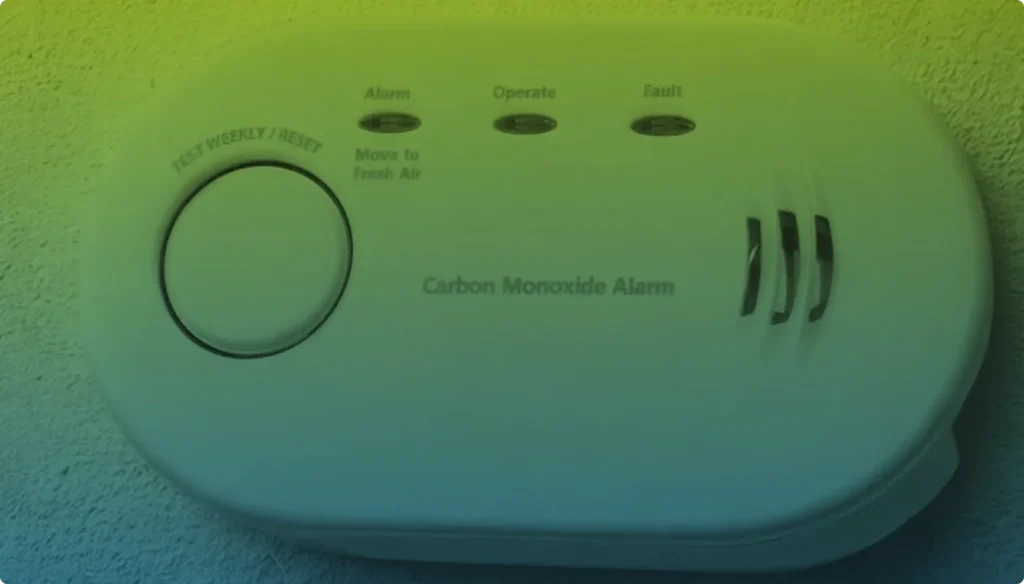
3Test your carbon monoxide alarm

Carbon monoxide has no smell, no colour and no taste. An audible alarm is the only thing that will tell you it is present. Three things to check:

  • It carries the BS EN 50291 mark. Without it, it is not a CO alarm.
  • It is within its life — CO alarms expire after seven to ten years, and the date is printed on the casing.
  • There is one in every room with a fuel-burning appliance, including gas fires, wood burners, oil boilers and LPG appliances.

Press the test button. If it does not sound, replace it today.

4Know the symptoms of CO posioning

The symptoms look like flu, which is exactly why they get dismissed: headaches, dizziness, nausea, breathlessness, tiredness, confusion, collapse.

The detail worth remembering

If the symptoms ease when you leave the house and return when you come back, or if more than one person has them at once, treat it as carbon monoxide until proven otherwise.

5Check your engineer is on the register

Anyone working on gas appliances in the UK must be on the Gas Safe Register by law. Every registered engineer carries an ID card with a photograph, a licence number and an expiry date, and the back lists the specific work they are qualified for. Be aware that someone qualified on cookers is not necessarily qualified on your boiler.

Ask to see the card. Any engineer worth having will hand it over without being asked twice.

If you smell gas

0800 111 999

National Gas Emergency Service. Free, 24 hours. You do not need to be certain before you call.

Open doors and windows, turn the gas off at the meter if you can reach it safely, avoid light switches, electrical appliances and naked flames, and get anyone who feels unwell into fresh air.

If you are a landlord in Norwich or Norfolk

Under the Gas Safety (Installation and Use) Regulations 1998, if you let a property with gas appliances you must:

  • Have every gas appliance and flue checked every 12 months by a Gas Safe registered engineer
  • Give tenants a copy of the record within 28 days, and new tenants a copy at the start of the tenancy
  • Keep copies for at least two years
  • Maintain appliances and pipework in a safe condition

The failure we see most often is certificates lapsing because nobody was tracking renewal dates across several properties. We can hold those dates for you.

Off the gas grid? The checks still apply

LPG appliances fall under the same Gas Safe regime as natural gas, and the engineer needs the specific LPG qualification on their card. The carbon monoxide risk is identical, and so is the case for an annual service.

If you have an air source heat pump there is no combustion, so no carbon monoxide risk. There is still a strong case for annual servicing: refrigerant, airflow, filters and control settings all drift, and performance falls away quietly rather than failing outright.

We service and repair heat pumps whoever installed the system but we do not install them ourselves.

Frequently asked questions

When is Gas Safety Week 2026?

Monday 14 to Sunday 20 September 2026. It is an annual campaign coordinated by Gas Safe Register, and the 2026 theme is “Take No Chances”.

How often should a boiler be serviced?

Once a year. Most manufacturer warranties require an annual service by a Gas Safe registered engineer, and skipping one can invalidate the cover.

Do landlords legally need a gas safety certificate?

Yes. Every 12 months, by a Gas Safe registered engineer, with a copy to tenants within 28 days and records kept for two years.

Where should a carbon monoxide alarm be fitted?

In every room with a fuel-burning appliance, at head height, roughly one to three metres from the appliance and not directly above it or in a cupboard.

How do I check an engineer is Gas Safe registered?

Ask to see their ID card and check the licence number, expiry date and the qualifications listed on the back. You can verify the number with Gas Safe Register directly.

What should I do if I smell gas?

Call 0800 111 999 straight away, open doors and windows, turn the gas off at the meter if it is safe, and avoid switches, appliances and naked flames.

Book a boiler service in Norwich

We are Gas Safe registered, and we have serviced, repaired and replaced boilers across Norwich and the surrounding Norfolk villages for over 35 years.

A full service takes around an hour, costs available on request, and you get a written record of what was checked and anything worth watching

Talk to someone local

Call the office, and you will speak to someone who knows the area, not a call centre. If it is easier, send us a message and we will come back to you.

Call 01603 457009  · Monday to Friday, 8am–5pm, and Saturday by appointment only.

More insights.

What are the rules on Carbon Monoxide (CO) alarms in England?

Carbon monoxide (CO) is often called the silent killer; a colourless, odourless, and tasteless gas that can be deadly when inhaled. It’s produced when fuels such as gas, oil,...

Learn more

Regulations

What Is the Gas Safe Register and Why It Matters for Your Safety

When it comes to gas appliances in your home or business, safety isn’t just important; it’s essential. Faulty gas work can lead to serious risks, including gas leaks, fires,...

Learn more
Regulations

Looking for an energy-efficient upgrade?

Upgrading is one of the smartest ways to reduce running costs and benefit from reliable warmth. We’ll help you find the best solution for your unique needs.

Name(Required)
Postcode
Smart homes.
Smart heating.
Smart life.

Dedicated team in Norwich with over 35 years experience.
